

11.26.2026
What if some of your biggest opportunities to grow revenue, improve margins, and reduce business risk are buried in information you already own?
According to a 2026 study by BARC, 70% of respondents can find and use less than half of their unstructured data for analytics or AI. Think historical contracts, financial records, customer correspondence, and decades of operational documentation, all potentially rich with business intelligence that never makes its way into a boardroom discussion.
It's part of a much bigger phenomenon known as dark data, and as executives head into 2027 looking to maximize returns on their technology investments, it raises an interesting question: should businesses be investing more in acquiring new intelligence, or getting better at uncovering what they already have?
What is dark data?
Dark data is information that a business collects, processes, and stores but doesn't actively use for analysis, decision-making, or other business purposes.
And despite its somewhat ominous name, there's nothing particularly mysterious about it. Much of it is a natural byproduct of doing business. Every transaction, customer interaction, inspection, and signed agreement generates information, some of which serves an immediate purpose before being filed away and largely forgotten.
Take a commercial lease, for example. Your finance team might have captured the monthly rent and payment terms in your accounting system, but what about the renewal conditions, maintenance responsibilities, or provisions for negotiating future rates? That information could remain tucked away in a PDF for years, only resurfacing when someone knows to go looking for it.
As IBM explains, dark data can be structured, semi-structured, or unstructured. In other words, it's not necessarily the format of the information that makes it dark, but rather whether your business is putting it to use.
Here are just a few reasons why data goes dark:
The "just in case" mentality. Information is retained because it might be useful someday, without a clear plan for how or when.
Organizational silos. Information collected by one department could be incredibly valuable to another, but neither knows what the other has.
Technology changes. As businesses upgrade their systems, historical records are often left behind in legacy applications or disconnected archives.
Accessibility barriers. Information exists in formats that are difficult to search, extract, or analyze, making it more trouble than it's seemingly worth.
A lack of ownership. Business priorities change, people leave, and nobody is quite sure who is responsible for the information left behind.
Of course, not all dark data is a goldmine waiting to be discovered. Some of it is redundant, obsolete, or just plain irrelevant. The challenge is figuring out which information deserves a second look, and which is just taking up space.
Where is all this dark data hiding?
You don't necessarily need to venture into the depths of your IT infrastructure to find dark data. In fact, some of the most interesting discoveries could be made in the less glamorous corners of your business, from the records room down the hall to the shared drive that hasn't been reorganized since 2012.
Here are a few places worth investigating:
Physical records and archives. Decades of contracts, invoices, inspection reports, engineering drawings, and other business records that may never have made their way into a digital system. This is especially common in industries that retain records for compliance purposes, like financial services, energy, property management, or utilities.
Digital document repositories. Scanned PDFs, SharePoint libraries, and shared folders filled with documents that are technically digital but difficult to search or analyze at scale.
Legacy business systems. Historical sales, financial, and operational data left behind when your business migrated to newer software.
Emails and internal communications. Years of customer feedback, supplier negotiations, project decisions, and institutional knowledge scattered across inboxes and messaging platforms.
Operational systems and equipment. Machine logs, maintenance histories, and sensor readings that are collected routinely but rarely examined beyond their immediate operational purpose.
As Splunk points out in its 2025 exploration of dark data, businesses often analyze what customers purchased, but overlook everything they searched for, considered, or added to their shopping carts before abandoning a purchase. It's a great example of how the information we choose to measure can tell a very different story from the information we leave out.
Now, think about the reports your leadership team relies on to make strategic decisions. How much of your organization's collective knowledge actually makes it into those reports, and what might change if you had a more complete picture?
The hidden economics of dark data
Dark data rarely appears as a line item on a balance sheet, which is perhaps why it doesn't get much airtime in executive meetings. But look a little closer, and its financial implications start showing up across the business, from the cost of maintaining information to the revenue opportunities that go unnoticed.
There are three sides to this equation worth exploring.
1. What you're paying to keep it
Whether you're renting warehouse space for boxes of historical records or paying for cloud storage, retaining information comes at a cost. Factor in the resources required to secure, maintain, retrieve, and manage that information, and the bill becomes considerably more complicated than the price of storage alone.
There's also the human cost. Every time an employee spends an afternoon hunting down an old agreement, reconciling information across multiple systems, or recreating a report that already exists somewhere, your business is effectively paying for the same information twice.
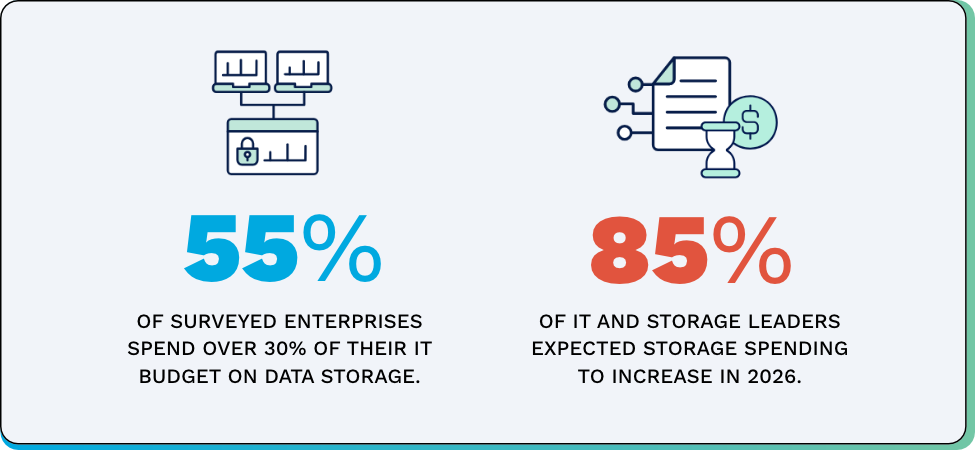
In fact, according to Komprise's 2026 State of Unstructured Data Management Report, 55% of surveyed enterprises spend more than 30% of their IT budget on data storage, and 85% of IT and storage leaders anticipated that spending would increase in 2026.
That's a sizable investment, particularly when you consider how much of that information may never contribute to a business outcome.
2. What you're losing by not using it
Perhaps the more interesting side of the equation is the opportunity cost of dark data. What could your business be earning, saving, or doing differently if it had better visibility into the information it already owns?
Consider contracts alone. October 2026 research from World Commerce & Contracting found that organizations measuring contract value erosion lose nearly 9% of contract value on average, with much of that loss occurring after the contract is signed.
While inaccessible information is only one potential contributor to that loss, it begs an interesting question about what happens to contracts after they're negotiated, celebrated, and filed away.
Imagine a business with $20 million in annual recurring customer contracts, some of which contain provisions for annual price increases. If just a quarter of those contracts have an overlooked 3% price escalation clause, that's $150,000 in potential annual revenue sitting in documents the business already owns.
And that's just one type of information, in one department, across one year.
3. What you're risking by not knowing what's in it
Dark data can also harbour some rather unwelcome surprises. Personally identifiable information retained beyond its required retention period, overlooked contractual obligations, outdated safety documentation, and confidential business information stored in forgotten repositories can all create financial, legal, and reputational exposure.
The implications extend to business continuity, too. If a long-serving employee retires tomorrow, how much of their institutional knowledge could your business recover from its existing records, and how much would effectively walk out the door with them?
Ultimately, the business case for addressing dark data isn't about making every piece of information useful. It's about gaining enough visibility to distinguish an asset from an expense, or worse, a liability.
AI is changing the economics of dark data
Until relatively recently, there was a perfectly reasonable economic argument for leaving much of this information untouched. The time and resources required to manually review thousands of documents, extract relevant information, and make sense of it all could easily outweigh the anticipated return.
AI is rewriting that reality. Advances in intelligent document processing, natural language processing, and automated data extraction mean businesses can now interrogate vast amounts of previously untapped information at a fraction of the manual effort.
Imagine being able to ask which of your supplier agreements are due for renegotiation in the next six months, identify recurring causes of equipment failure across a decade of maintenance reports, or uncover patterns in historical insurance claims without assigning a team of people to sift through thousands of documents.
These aren't necessarily new business questions, they're just becoming considerably more economical to answer. But there is a catch. AI can only work with the information it has access to, and that's where many businesses are running into trouble.
A 2026 survey commissioned by Cloudera of 1,270 IT leaders revealed an interesting disconnect: while 85% of organizations reported having a clear data strategy, nearly 80% said that limited access to their data was still holding back their AI and data initiatives.
Cloudera calls this the "AI readiness illusion," and it's a concept worth reflecting on as businesses finalize their technology budgets for 2027.
After all, purchasing a sophisticated AI solution and giving it access to only a fraction of your organization's knowledge is a bit like hiring a brilliant consultant and withholding half the briefing materials. You might get some interesting answers, but are they the best answers your business could be getting?
Of course, making dark data accessible to AI doesn't mean feeding decades of records into a large language model and hoping for the best. Information needs to be relevant, accurate, appropriately governed, and available in a format that AI can reliably interpret.
For executives looking to maximize their AI ROI, this presents an important shift in thinking: making your existing information usable is part of the AI investment itself.
Dark data discovery: How to find out what information your business is sitting on
The prospect of investigating decades of accumulated business information might sound like an enormous undertaking, but dark data discovery doesn't have to begin with an organization-wide audit. In fact, you're probably better off starting somewhere much more specific.
The key is to approach discovery as a business initiative rather than a data management project, working backwards from the outcomes you want to achieve.
1. Start with a business question
One way to begin is rather than asking what data your business has, start by asking what you wish you knew. Where are your margins being squeezed? Which operational decisions rely a little too heavily on gut instinct? Where could better information give you more leverage in commercial negotiations?
Starting with a tangible business problem gives your discovery efforts a purpose and, importantly, a way to measure their success.
2. Follow the information trail
Once you've identified a business question worth answering, consider where the information that could help answer it might live.
If you're looking to reduce procurement costs, for example, your investigation might lead you to historical supplier agreements, purchase orders, and invoices. If you're looking to improve operational efficiency, maintenance records and inspection reports might be a more fruitful starting point.
Involve the people closest to these processes, too. They often know exactly where the information bottlenecks are, even if leadership has never had visibility into them.
3. Test the waters before diving in
You don't need to digitize an entire warehouse of records to determine whether there's value inside. Start with a representative sample of documents or records, extract the relevant information, and evaluate what it tells you.
Did you uncover previously unidentified savings? Discover a pattern that could inform a business decision? Find information that would save your team hours of manual work every month?
A small discovery exercise can help you quantify the potential return before committing to a larger investment, making it considerably easier to build an evidence-based business case.
4. Separate the valuable from the expendable
As IBM notes in its recommendations for managing dark data, effective data governance includes establishing clear policies for what should be retained, archived, or destroyed.
Depending on what your discovery efforts reveal, you'll likely find information that falls into three categories:
Information worth activating: Records that could contribute to better decisions, financial performance, operational efficiency, or AI initiatives.
Information worth retaining: Records that need to be kept for legal, regulatory, or business continuity purposes, even if they don't have an immediate analytical use.
Information worth letting go of: Redundant, obsolete, or irrelevant data that can be securely destroyed, provided retention requirements and legal obligations are met.
Sometimes, the return on dark data discovery comes from having less data to manage, not more.
5. Put your discoveries to work
Finding valuable information is one thing, but making it part of how your business operates is another. Depending on the source, this could involve extracting and verifying information from historical documents, integrating it into existing business systems, making it accessible to AI tools, or building automated workflows around it.
Establish clear ownership and processes for capturing and managing new information, too. Otherwise, you risk finding yourself back in the same position five years from now, with a whole new collection of dark data waiting to be discovered.
Before you invest in more intelligence, look at what you already own
As you look ahead to 2027, consider how much of your technology budget is set aside for acquiring new capabilities, and how much is dedicated to getting more value from the assets your business already owns.
There's a good chance some of your most interesting business insights aren't waiting to be generated, but waiting to be discovered.
At WCD, we're helping businesses explore one particularly overlooked source of dark data: their historical documents. Through Intelligent Scanning, we transform paper records and existing scanned archives into verified, structured data that your people, systems, and AI can put to good use.
And you don't need to commit to a large-scale digitization project to find out what's worth uncovering. Give us one box or one high-value document type, and in just seven days, we'll show you what could be hiding in your records.
You might be surprised by what your business has been sitting on.
Get started with Intelligent Scanning →