

09.22.2026
As businesses race to scale AI, intelligent intake—the process of identifying, validating, contextualizing, and routing business information—is bringing new attention to an overlooked question: what happens to data the moment it enters your organization?
Imagine that you work for a large insurance company that processes thousands of claims every week. At any given moment, an abundance of information is entering the business—whether it be through online forms, email attachments, broker submissions, or traditional mail—all of which need to be identified, validated, matched to the right customer, and routed to the right place before a claim can move forward.
You might assume most of that happens automatically. In reality, employees inside large organizations are often still opening attachments, re-keying details, cross-referencing systems and deciding where information belongs. It’s an invisible yet significant back-office problem.
Then, enterprise AI entered the picture.
Information intake has always created inefficiency, but now, AI is seriously raising the stakes. If your business is using AI to analyze information, recommend decisions, and automate more complex workflows (or plans to in the future), the quality and context of the information feeding those systems becomes much more consequential. For that AI investment to pay off, the right information must reach those systems in a form they can understand and trust.
The AI Race Is Running Into A Data Problem
For the last few years, much of the enterprise AI conversation has centred on models, copilots and (increasingly) agents. But as organizations try to move AI from impressive demos into real business processes, something much less exciting is getting in the way: their data.
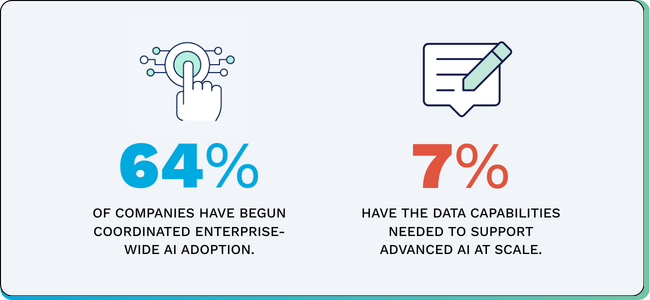
In a 2026 study of executives at 2,000 companies, Accenture found that 64% said their organizations had moved beyond isolated AI pilots or begun coordinated enterprise-wide adoption. Yet just 7% had progressed far enough in building the data capabilities considered necessary to support advanced AI at scale.
McKinsey has identified a similar constraint. As organizations push AI pilots toward scale, data readiness becomes a limiting factor, particularly when businesses must connect structured data with the vast amount of information held in documents, emails, and other unstructured formats.
In other words, buying or building the AI is only part of the problem. You also have to give it something worth working with.
And that raises a question that gets far less attention: What happens to all the new information entering your business tomorrow? The invoices. Applications. Contracts. Customer emails. Forms. Claims. PDFs. Images. API calls. Physical mail.
Sure, cleaning up the information you already have stored in file folders, bankers boxes, and digital systems is a challenge. But making sure you aren't creating tomorrow's data problem with every new piece of information that arrives is another.
The Front Door To Your Business Is Still Surprisingly Manual
Inside large organizations, information rarely enters through one neat channel. It arrives everywhere. This is why a process called intelligentintake is taking centre stage.
Matt Christensen, Director of Digital Transformation and Innovation at WCD, describes intelligent intake as governing those different entry points and turning incoming information into valuable context the business can use.

The goal with intelligent intake is to make all forms of information coming into a business usable, whether that means routing it intelligently, starting a workflow, or giving AI the context it needs."
Without intelligent intake processes in place, Christensen has firsthand seen how quickly complexity can build inside large businesses. In one government organization, employees were responsible for sorting incoming information across more than 100 different document types, each with its own place in an extensive filing structure. Knowing exactly where something belonged often depended on experience and institutional knowledge, which became especially challenging for smaller offices with fewer people to rely on.
Intelligent intake can take much of that guesswork out of the process by identifying what a document is, extracting the relevant information, and applying the right classification and context as it enters the organization. That matters even more as businesses begin connecting AI to their enterprise information, because a document that is misclassified, poorly labelled or difficult to find can affect what information an AI system finds, how it interprets it and, ultimately, the answer or action that comes next.
Why Your Enterprise AI Needs Contextual Clarity
Giving AI access to your company's information is one thing, but giving it enough context to understand that information is another. Christensen points to the oil and gas industry to paint the picture for us: a general-purpose AI model might know a tremendous amount about chemical engineering, but it doesn't know your company's standard operating procedures, the history of a particular well site, its pressure readings, or what happened during its last maintenance cycle. That knowledge is specific to your business, and it often lives across documents, systems, and the people who know how to interpret them.
Context is king with AI. If you don’t control the context your AI has access to, you can’t control the quality of what you get back. Intelligent intake becomes part of that context control.”
Think about something as ordinary as a customer complaint. Knowing that an incoming email is a complaint is useful, but knowing that it comes from a major customer, references a recurring issue, and contains language suggesting possible legal action signals to run this particular complaint up the chain of command, immediately. When incoming information can be understood with a contextual layer applied, the system can make a much more informed decision about how to move or escalate it to correct people or systems.
Intelligent intake gives us the ability to route information based on context, not just document type. You can understand the urgency of what’s happening and bring in information from other systems to determine what should happen next.” — David VanDerEems, Senior Consultant, Enterprise Transformation
That's where intelligent intake starts to look very different from even traditional automation. The goal is multi-purpose: to get information into the business faster, and to make sure it arrives with enough context to be useful once it's there.

Taking Business Data From AI-Ready to Agent-Ready
The flip side of giving AI access to more of your business is that bad information can travel further, too. VanDerEems comes back to one of technology’s oldest principles: “garbage in, garbage out.”
If you’re using AI to help make important business decisions, governing the information going into it becomes critical. The higher the stakes of the decision, the more important it is that you can trust the data behind it.”
This is especially important as AI moves from answering questions to taking action. It’s no longer just “AI-ready data” but also “agent-ready data” that organizations need to consider. AI agents increasingly use enterprise information to reason, make recommendations and initiate workflows. And because of this, the progression of enterprise information management is starting to look something like this:
Intelligent Scanning: Turn historical paper documents and other physical records into digital information that can be searched, accessed and used across the business. With an added layer of data extraction, that can also mean capturing the information inside those documents so it can be used by other systems and your enterprise LLMs.
Intelligent intake: Understand all forms of data as they enter the organization's many “front doors” for information (like the mailroom, customer service inbox, or support call transcripts). That means identifying what it is, extracting and validating key information, adding the right context, and routing it based on what the business needs to happen next.
Automation: Put that digital information to work by moving it through repeatable processes with less manual intervention, whether that means routing an invoice for approval, updating a customer record, or triggering the next step in a workflow.
AI & Analytics: Give AI systems the ability to use that trusted, contextualized information to reason across business data, make recommendations, and increasingly take action with agentic workflows, from resolving routine requests to initiating actions across multiple systems.
Each step expands what a business can do with its information, and raises the cost of getting that information wrong at the beginning. Weak intake does not stay at the front door; it compounds through automation, analytics, and agentic workflows.
Your AI Strategy Has A Front Door
When leaders think about AI readiness, much of the focus naturally falls on the information their organizations already have: consolidating systems, cleaning up data, digitizing archives, and making enterprise knowledge accessible to AI. But even if you get all of that right, new information will start arriving again tomorrow.
Every email, form, document, image, and transaction has the potential to become part of the knowledge your AI relies on. Intelligent intake is about making sure that information enters the business in a way that makes it useful from the start, with the right validation, classification, and context attached to it.
So, as AI takes on more consequential work inside the business, leaders must ask more than which models, tools, and agents to invest in. They must also ask: How confident are we that the information entering the organization is accurate, contextualized, and ready for AI to act on?
Interested in Intelligent Intake?
Bring us your most pressing questions and we’ll book some time to talk.